Every winter, humpback whales leave their summer feeding grounds in the North Pacific and swim south to Banderas Bay to mate, give birth and raise their calves in warm water. For a few months you can watch them breach, slap their tails and spout from the deck of a boat, and sometimes from the beach. Whale watching in Puerto Vallarta is one of the big reasons to visit between December and March. This guide covers when to go, including the official 2026 to 2027 season dates, what you will see out on the bay, how to choose a tour, and how to spot whales without getting on a boat at all.
When is whale season in Puerto Vallarta?
The official Puerto Vallarta whale watching season runs from early December to late March. For 2026 to 2027, tour operators list December 8, 2026 as opening day, and the season closes in late March 2027. Those are the dates when permitted boats are allowed to take tours out to see the whales.
There is an official season because whale watching tours operate under Mexican federal rules. Operators need a permit, and the rules limit how close boats can get to the whales and how long they can stay with them. They protect the humpbacks while they are mating and nursing their calves, and they are the reason a licensed boat will not take you whale watching in November even if whales have already arrived.
The whales do not read the calendar, though. Some show up in November and some stay into April, but boat tours to see them run only during the official whale season. Month by month, it looks like this:
- November: the first whales are arriving. No tours yet, but you might spot a distant spout from shore.
- December: the season opens on December 8. Early sightings, picking up through the month as more whales reach the bay.
- January and February: peak. The most whales in Banderas Bay, mothers with young calves, and the most reliable sightings.
- March: the season winds down as whales begin heading north. Tours end in late March.
- April: a few stragglers remain, but no tours run.
The best time for whale watching in Puerto Vallarta
Peak whale activity runs roughly from mid-December through February, and January and February are usually the best months for sightings. If your dates are flexible, aim for mid-January to late February: the whales are at their most active, the holiday crowds have gone home, and the weather is dry and sunny.
Early December is quieter on land and on the water, but with fewer whales in the bay the sightings are less predictable. The Christmas to New Year’s stretch gives you good whale activity along with the busiest weeks of the year, so book tours early if that is when you are coming.
What you’ll see whale watching in Puerto Vallarta
The stars of the show are humpback whales. They come to Banderas Bay for the same reasons every year: the warm, sheltered water is where they mate, where pregnant females give birth, and where mothers spend the first months with their calves before the long swim back north.
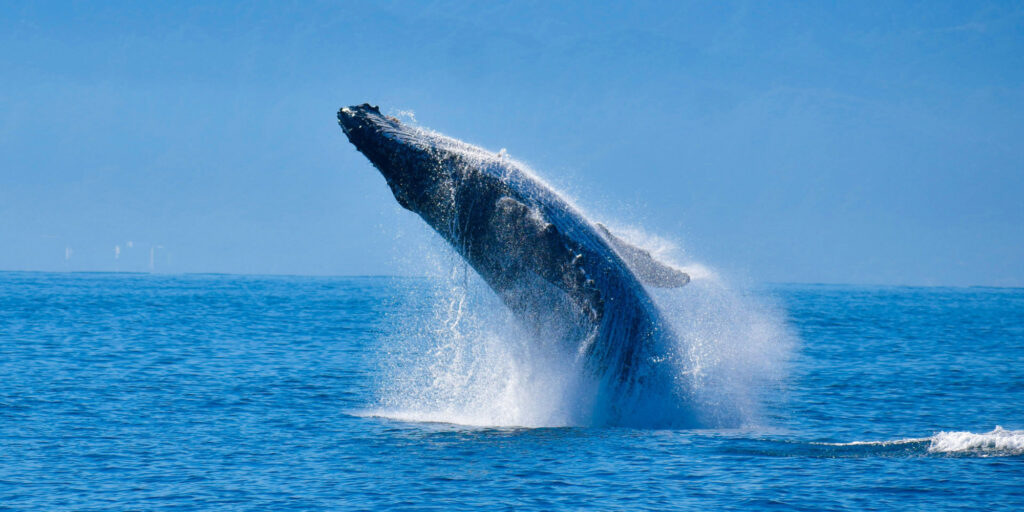
On a typical tour with humpback whales you can expect to see spouting, the tall puff of spray as a whale exhales at the surface, and if you are lucky a breach, when a whale throws most of its body out of the water and crashes back down. Tail slaps and pectoral fin slaps are common too, and they carry across the water. Mothers with calves are a highlight of the season: the calves are born in the bay and spend their first weeks nursing, resting close to mom and practicing their own clumsy breaches.
Male humpbacks also sing during the breeding season. Some tours bring a hydrophone, an underwater microphone, so you can hear the songs on deck. If that matters to you, ask whether it’s included when you book. Keep in mind that these are wild animals: no tour can promise what you will see, and every trip is different.
Other wildlife in Banderas Bay
Whales are not the only animals in the bay. Dolphins are often seen on whale watching tours, sometimes riding alongside the boat, and sea turtles pop their heads up at the surface. Seabirds work the water around the boat. Orcas are occasionally reported in the bay as well, though they are a rare bonus rather than something to plan around.
How to choose a whale watching tour in Puerto Vallarta
Puerto Vallarta whale watching tours come in a few styles, and the right one depends on who you are traveling with and how you handle a boat.
Big boat or small boat?
- Large catamarans and sailboats. The most comfortable option. They are more stable in the swell, which makes them a good choice for families and for anyone prone to seasickness, and most serve food and drinks on board. The trade-off is more people on deck and a bit more distance between you and the water.
- Small-boat and eco tours. Fewer passengers, often with a marine biologist or naturalist as your guide. These trips tend to be more flexible and personal, and you sit closer to the water, so you feel every breach and every wave. Better for photographers and anyone who wants the guide’s full attention.
- Private charters. Your own boat for a family or group. You set the pace and the guest list, and the crew can tailor the trip to you. You pay for the whole boat, so these make the most sense when you have enough people to share it.
Many tours run about two to four hours. Some combine whale watching with a stop at one of the bay’s snorkeling spots, a beach stop or a dolphin experience, which stretches the day and suits travelers who want more than one activity in a single outing.
Where tours leave from
Tours depart from several points around the bay. In the city, the main departure areas are the Maritime Terminal and Marina Vallarta, on the north side of town. Farther north, boats also leave from Nuevo Vallarta and from the towns along the north shore of the bay, such as La Cruz and Punta de Mita. In the Romantic Zone, smaller boats also leave from the Los Muertos pier, at the south end of Los Muertos Beach.
Choosing a departure point close to where you are staying saves you time and an early alarm. If you are in the Hotel Zone, Marina Vallarta is an easy ride. From the Romantic Zone, the Los Muertos pier is a short walk, or ask whether a Marina Vallarta tour includes transportation.
What to look for in a tour company
Start with the rules: choose a permitted operator that follows the federal whale watching regulations, keeps a respectful distance and does not chase or crowd the animals. A naturalist or marine biologist on board turns a boat ride into an education, so ask who will be guiding. If crowds matter to you, ask about group size. Some tours are sold as “guaranteed” sightings, but read the terms: most refund policies depend on cancelling ahead, not on whether the whales show up. Ask in writing what happens if you don’t see any. And read recent reviews, not just the ones on the operator’s own site.
For a wider look at what is on offer on the water and in the hills, see our guide to the best Puerto Vallarta tours.
Tips for your tour
- Book ahead in peak weeks, especially from Christmas through New Year’s and in February, when boats fill up.
- Consider a morning departure. Mornings often have calmer water before the afternoon breeze picks up.
- Pack for sun and wind. Sunscreen, a hat and a light layer, since it can feel cooler on the water than on the beach.
- Take motion-sickness tablets before you board if you get seasick, and pick a larger boat.
- Bring binoculars or a phone with good zoom. The whales do not always come close.
- Wear polarized sunglasses. They cut the glare and make it much easier to spot spouts on the water.
Can you see whales from shore?
Yes, sometimes. In December and January especially, you can spot humpback whales in Puerto Vallarta without a boat: a spout or a breach far out on the bay, usually a flash of white water that is gone before everyone else turns around. The Malecón and the beaches both work, and the higher you are the better your chances, so a high balcony or a rooftop with a bay view gives you the widest stretch of water to scan.
That is one of the perks of staying somewhere with a view. From our beachfront condos in the Hotel Zone, in buildings such as Harbor 171 and Grand Venetian, guests can see whales right from the balcony when they are in the bay. Most of our homes in Amapas and Conchas Chinas, on the hillside just south of the Romantic Zone, look out over the bay too, and whales show up in those views as well. In the Romantic Zone itself, only condos with the right ocean view can see them, so if whale spotting from home matters to you, tell us when you book and we will point you to the right places. Keep binoculars by the window and glance up from your coffee now and then.
A boat tour is still the reliable way to see whales in Puerto Vallarta up close. From shore you get the occasional long-distance show; from the water you get the whole animal.
Planning a trip around whale season
Whale watching season lines up with high season, the holidays and the nicest weather of the year: dry, sunny and warm, with cooler evenings. That makes it a popular time to visit, so book your rental and your tour early, especially from Christmas through New Year’s and again in February. For more on the weather, see our guide to the best time to visit Puerto Vallarta.
If you are coming for the holidays, our guides to December in Puerto Vallarta and to spending New Year’s Eve in Puerto Vallarta cover what to expect in town while the whales are in the bay.
On where to stay: the Hotel Zone gives you beachfront buildings with ocean views and an easy ride to the Marina Vallarta departures, while the Romantic Zone puts you within walking distance of the restaurants and the Malecón. Our guide on where to stay in Puerto Vallarta compares the neighborhoods in more detail.
Want whales from your balcony? Ask us for a beachfront Hotel Zone condo or a hillside home in Amapas or Conchas Chinas. Ready to plan? Check availability for whale season, and book direct with us to skip the platform fees.
Whale watching in Puerto Vallarta: FAQ
When is whale season in Puerto Vallarta?
The official whale watching season runs from early December to late March. For 2026 to 2027, tours start on December 8, 2026 and the season closes in late March 2027. Whales can arrive in November and a few stay into April, but boat tours run only during the official season.
What is the best month for whale watching in Puerto Vallarta?
January and February are usually the best months, with peak activity running from about mid-December through February. That is when the most humpback whales are in Banderas Bay, including mothers with calves. Late January and February also fall after the holiday crowds have left.
Can you see whales from the beach in Puerto Vallarta?
Sometimes, especially in December and January. Look for spouts and breaches far out on the bay from the Malecón, the beaches or a high balcony or rooftop with a bay view. Beachfront condos in the Hotel Zone and hillside homes in Amapas and Conchas Chinas often have that view. A boat tour is the reliable way to see them up close.
How long is a whale watching tour?
Many whale watching tours in Puerto Vallarta run about two to four hours. Combination trips that add snorkeling, a beach stop or a dolphin experience take longer, often most of a day. Check the itinerary when you book.
Do I need to book a whale watching tour in advance?
In peak weeks, yes. Boats fill up from Christmas through New Year’s and again in February, so book as soon as your dates are set. Outside those weeks you can often book a day or two ahead, but reserving early still gets you the boat and departure time you want.